
The Vampire Facial: Marketing Versus Reality
The name was invented for a reality television moment, and it has done more for the treatment's bookings than any study ever will. Which is a shame, because underneath the name there's a real procedure with a coherent rationale, and the theatre makes it almost impossible to evaluate.
Strip the branding and it's this: microneedling, immediately followed by the application of platelet-rich plasma drawn from your own blood. Two established things, performed in sequence, on the theory that the second works better through the channels created by the first.
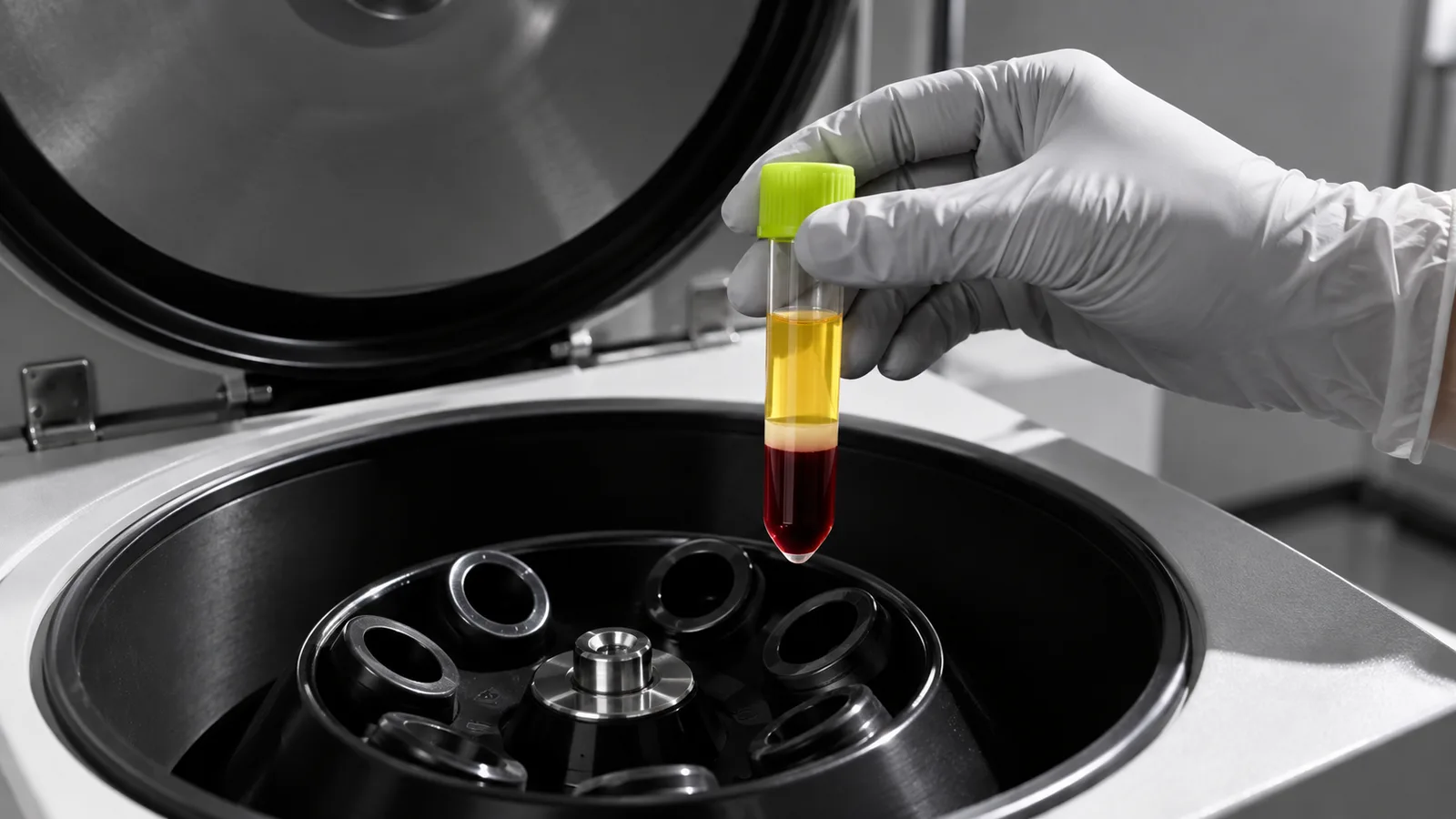
What actually happens in the appointment
Blood is drawn from your arm, the same as any lab test. It goes into a centrifuge for several minutes, which separates it into layers, and the platelet-dense layer is drawn off.
Meanwhile a device with fine needles is passed over your face at a set depth, creating a controlled pattern of tiny injuries. Your skin responds to injury by repairing, and that repair process is what produces the improvement in texture over the following weeks. This part is ordinary microneedling and works on its own.
The plasma is then applied over the freshly needled skin, or in some protocols injected. Numbing cream goes on beforehand. It takes an hour or so in total, and yes, your face is streaked with blood for part of it, which is the entire reason you've seen photographs of it.
What the evidence supports
Microneedling has reasonable support for texture, fine lines, and certain kinds of scarring over a course of sessions. That much is fairly settled.
The added value of the plasma on top is where things get thinner. There are studies suggesting the combination outperforms needling alone, and there are studies that don't find a meaningful difference. Protocols vary between papers in ways that make comparison awkward — different centrifuge settings, different platelet concentrations, different needling depths. The overall impression I come away with is that it probably adds something modest for some people, which is a much quieter claim than the one being made at the point of sale.
Notice what that means for the pricing. You're paying a significant premium over plain microneedling for an increment that the literature hasn't pinned down. Run any provider's description through the same test, including how one local practice lays out its PRP facials in Hoboken: count what's promised for the needling and what's promised for the plasma.
The claims worth rejecting
That it's a facelift. It isn't and can't be. Nothing done at this depth lifts anything.
That the effect is immediate. You'll be red, possibly swollen, and the actual improvement builds over weeks as the repair response plays out. Photographs taken the next day are showing you inflammation, not results.
That being your own blood makes it inherently safe. Autologous material avoids one category of risk, which is real and worth having. It doesn't make needling your face a trivial act. Infection risk is about sterile technique and equipment handling, not about whose plasma it is — and there's a well-documented case of exactly that going wrong at an unlicensed operation.
That one session does it. Three is the typical course, spaced a month or so apart, with maintenance after. Price the course.
Who it suits, and who it doesn't
It suits people with texture concerns, mild scarring, or general dullness who've already got a daily routine in place and want to step up.
It doesn't suit anyone with an active skin infection, a bleeding or clotting condition, certain autoimmune conditions, or a history of keloid scarring. It's not appropriate during pregnancy. If you're on a blood thinner, that's a direct conversation to have before booking rather than a detail to mention afterwards.
And if you bruise easily or you've got something in ten days, reschedule. Recovery is usually a few days of looking windburned, but "usually" is doing real work in that sentence.
What to ask before booking
What needling depth are you using and why that depth for my skin? How is the plasma prepared, and with what system? Who draws the blood? How many of these have you done? What's your protocol if I get an infection afterwards?
Then the money question, phrased properly: what does the full course cost, and what would you recommend after that to maintain it?
A note on where you're booking
I keep coming back to this because it's the part that actually varies. The procedure is reasonably standardized; the operation around it isn't. Practices in this area are mostly small independent businesses, many listed through groups like the North Jersey Chamber of Commerce, and local reporting at Weehawken Daily Voice | Your Local News for Weehawken, New Jersey is the quickest way to find out who's recently opened.
Neither of those tells you about sterile technique or training, which are the two things that matter most for this particular treatment. For anything on the regulatory or civic side, start with the township at Weehawken Township rather than a comment thread.
One practical scheduling note: recovery skin is sun-sensitive, and the days after are not the time for a long walk along the water. Glance at the forecast at National Weather Service before you pick a date.
The honest summary
It's microneedling with an add-on that may help somewhat. If you'd be happy with the results of microneedling alone, and you would be, start there and see. If you want the full version, fine — go in knowing you're paying for an increment rather than a category change.
And please don't pick it because of the name. The name is the least informative thing about it.